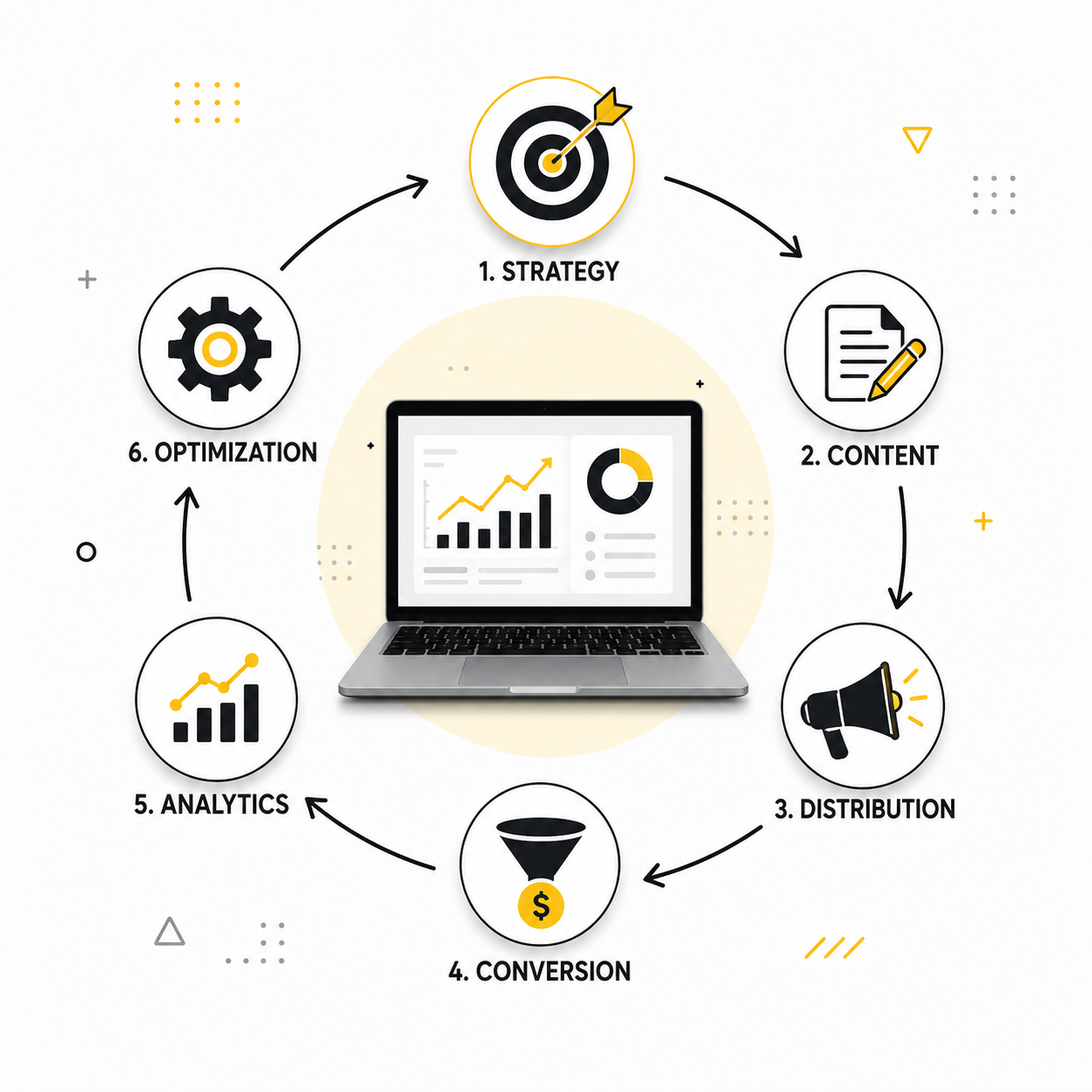
Marketing Is More Than Running Ads: Build a System, Not Just a Skill
Many people enter the marketing industry believing that if they can write content, run ads, or create attractive graphics, they already understand marketing.
The truth is, marketing is much bigger than that.
In leading companies across the US and Singapore, marketing is divided into multiple specialized roles. Each professional focuses on a specific area instead of trying to master everything.
Common Marketing Specializations
-
Chief Marketing Officer (CMO)
-
Product Marketing
-
Brand Marketing
-
Performance Marketing
-
Influencer Marketing
-
Content Marketing
-
Customer Relationship Management (CRM)
-
B2B Marketing
-
Marketing Analytics
-
Marketing Automation
-
Search Engine Optimization (SEO)
-
Email Marketing
-
Partnership Marketing
-
Community Marketing
-
Growth Marketing
-
Demand Generation
-
Marketing Operations
Most marketers specialize in only one or a few of these fields.
My Marketing Experience
Over the years, I have worked extensively in areas such as:
-
Chief Marketing Officer (CMO)
-
Brand Marketing
-
Product Marketing
-
Influencer Marketing
-
Content Marketing
-
Performance Marketing
-
Viral Marketing Campaigns
-
Guerrilla Marketing Campaigns
-
B2B Marketing
-
Customer Relationship Management (CRM)
I've had the opportunity to build, test, and teach strategies across these areas.
I also have some experience with Email Marketing and previously worked with SEO, although it's no longer my primary focus.
However, if you're planning to work with international clients, SEO and Email Marketing are still essential skills worth learning.
AI Makes Content Easier—But Strategy Still Wins
Today, AI can generate content within seconds.
But AI can't decide:
-
Which product should be positioned for which audience.
-
How a brand should stand out in a competitive market.
-
Which marketing channel delivers the highest ROI.
-
Which campaign has the potential to go viral.
-
Which customers have the highest lifetime value.
-
Which CRM strategy increases repeat purchases.
These are strategic decisions that still require human thinking.
The marketers who can answer these questions are the ones who will remain valuable in the AI era.
The Future Belongs to System Builders
Creating content is becoming easier every day.
Building a complete marketing system is what creates long-term business growth.
Don't study marketing as a collection of tools.
Study it as a business growth system.
Before Spending More on Ads, Ask These Questions
Every successful marketing strategy starts with understanding the customer.
Ask yourself:
-
What does the customer really want?
-
What are they afraid of?
-
Why haven't they purchased yet?
-
Why do loyal customers keep coming back?
If you can't answer these questions, increasing your advertising budget or posting more content will only produce limited results.
Marketing Is a Combination of Skills
The more I learn about marketing, the more I realize that success doesn't come from mastering a single skill.
Marketing is a system built from multiple interconnected skills.
1. Customer Research
Understand customer problems, needs, behaviors, and motivations.
2. Market Research
Study the market, competitors, and industry trends.
3. STP (Segmentation, Targeting & Positioning)
Identify the right audience and position your brand effectively.
4. Value Proposition
Clearly communicate why customers should choose you over competitors.
5. Branding
Build a strong brand identity, message, and trust.
6. Copywriting
Write headlines, ads, captions, and landing pages that convert.
7. Storytelling
Sell stories instead of simply selling products.
8. Content Marketing
Create valuable content through social media, blogs, videos, and email.
9. Social Media Marketing
Use platforms like Facebook, Instagram, TikTok, LinkedIn, and X strategically.
10. Performance Marketing
Manage paid advertising based on measurable ROI.
11. SEO
Generate organic traffic from search engines.
12. Email Marketing
Turn leads into customers and customers into loyal advocates.
13. Sales Funnel Design
Design the entire customer journey—from awareness to loyalty.
14. Offer Creation
Develop offers that customers find difficult to ignore.
15. Pricing Strategy
Set pricing that reflects your value while staying competitive.
16. Data Analytics
Understand metrics like CTR, Conversion Rate, CAC, ROAS, and Customer Lifetime Value (LTV).
17. A/B Testing
Continuously test creatives, headlines, offers, and campaigns to improve performance.
18. Marketing Automation
Leverage CRM systems, automated workflows, and AI-powered processes.
19. AI Marketing
Use AI to accelerate research, content creation, creative production, and campaign execution.
20. Strategic Thinking
Think beyond individual campaigns and focus on long-term business growth.
Marketing Learning Roadmap
🟢 Level 1 — Build a Strong Foundation
Start by understanding the fundamentals.
-
Customer Research
-
STP
-
Branding
-
Copywriting
By the end of this stage, you'll understand your customers, build stronger brands, and write persuasive marketing messages.
🟡 Level 2 — Customer Acquisition
Learn how to consistently attract new customers.
-
Content Marketing
-
Social Media Marketing
-
Offer Creation
-
Sales Funnel Design
At this level, you'll know how to turn attention into qualified leads.
🟠 Level 3 — Optimization
Replace guesswork with data-driven decisions.
-
Paid Advertising
-
SEO
-
Email Marketing
-
Analytics
You'll learn how to optimize budgets, improve conversions, and measure marketing performance.
🔴 Level 4 — Scale & Strategy
Think like a Marketing Manager, CMO, or Founder.
-
Marketing Strategy
-
Growth Marketing
-
Marketing Automation
-
AI Marketing
Instead of focusing on individual campaigns, you'll learn how to build scalable systems that drive sustainable business growth.
The Core Purpose of Marketing
Marketing is not about running ads.
Its real purpose is to:
-
Find the right customers.
-
Understand their problems.
-
Offer meaningful solutions.
-
Build lasting relationships that encourage repeat purchases.
There Are No Shortcuts
Don't run ads without a solid foundation.
Don't create content without understanding your audience.
Don't spend marketing budgets without reading the data.
The journey is simple—but it requires discipline.
Foundation → Customer Acquisition → Optimization → Scale
Follow this path consistently, and you'll become more than just a marketer.
You'll become someone capable of leading the growth of an entire business.
